Hazard Communication
What is Hazard Communication Standard?
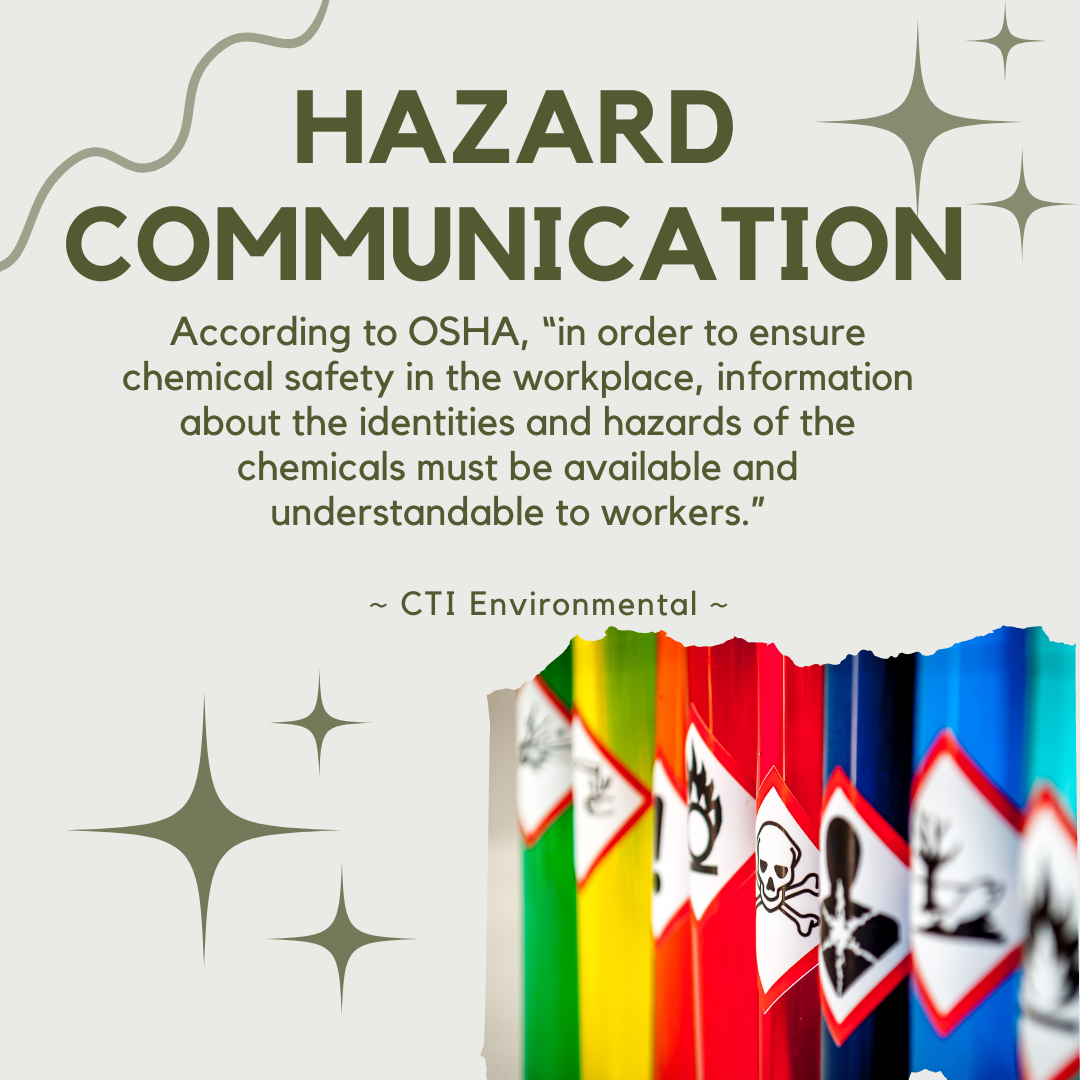
According to OSHA, “in order to ensure chemical safety in the workplace, information about the identities and hazards of the chemicals must be available and understandable to workers.” The Hazard Communication Standard (HCS) by OSHA calls for the “chemical manufacturers and importers to evaluate the hazards for the chemicals they produce or import, and prepare labels and safety data sheets to convey the hazard information to their downstream customers.” It also requires, “all employers with hazardous chemicals in their workplaces to have labels and safety data sheets for their exposed workers, and train them to handle the chemicals appropriately.”
1910.1200 - Hazard Communication
The Hazard Communication Standard is under 1910.1200 (subpart Z). The change that has been made to this standard is consistent with the provisions of the United Nations Globally Harmonized System of Classification and Labelling of Chemicals (GHS). The Hazard Communication Page on OSHA has downloadable versions of the 1910.1200 Final Rule and appendices that are updated to align with GHS.
What is the Globally Harmonized System?
According to OSHA the Globally Harmonized System (GHS), “is an international approach to hazard communication, providing agreed criteria for the classification of chemical hazards, and a standardized approach to label elements and safety data sheets. The result of this change and negotiation process resulted in a document entitled, Globally Harmonized System of Classification and Labeling of Chemicals” also known as The Purple Book. The documents provide criteria for the health, physical, and environmental hazards of chemicals, as well as standardized label elements, signal words, and a standardized information safety data sheet.
Why did OSHA modify the Hazard Communication Standard to adopt the GHS?
The fundamental reason why they modified the standard is to improve the safety and health of workers through more effective communications on chemical hazards. The initial standard is performance-oriented, allowing manufacturers to put their information on labels and material safety data sheets in whatever format they choose. The GHS is more effective using a standardized approach. This includes detailed criteria for determining what hazards affect a chemical. According to OSHA, this approach will, “enhance both employer and worker comprehension of the hazards, which will help to ensure appropriate handling and safe use of workplace chemicals.” Adopting GHS will improve all the information that is received from other countries, considering that the US is a major importer and exporter of chemicals, it is more efficient for the labels and safety data sheets to be standardized.
Definitions for the Hazard Communication Standard
According to OSHA, these are key definitions and changes that were recently made to the Hazard Communication Standard:
- Hazard classification: Provides specific criteria for the classification of health and physical hazards, as well as classifications of mixtures.
- Labels: Chemical manufacturers and importers will be required to provide a label that includes a harmonized signal word, pictogram, and hazards statement for each hazard class and category. Precautionary statements must also be provided.
- Safety Data Sheets: Will now have a specified 16- section format.
- Information and training: Employers are required to train workers on the new labels elements and safety data sheets format to facilitate recognition and understanding.
OSHA’s Steps to an Effective Hazard Communication Program for Employers That Use Hazardous Chemicals
- Learn the standard and identity the responsible staff.
- Prepare and implement a written hazard communication program.
- Ensure containers are labeled.
- Maintain safety data sheets.
- Inform and train employees.
- Evaluate and reassess your program.
If you would like to learn more about each step, click here to view OSHA’s recommendations.
Citations
https://www.osha.gov/hazcom/faq